The County Line Woodwind Ensemble
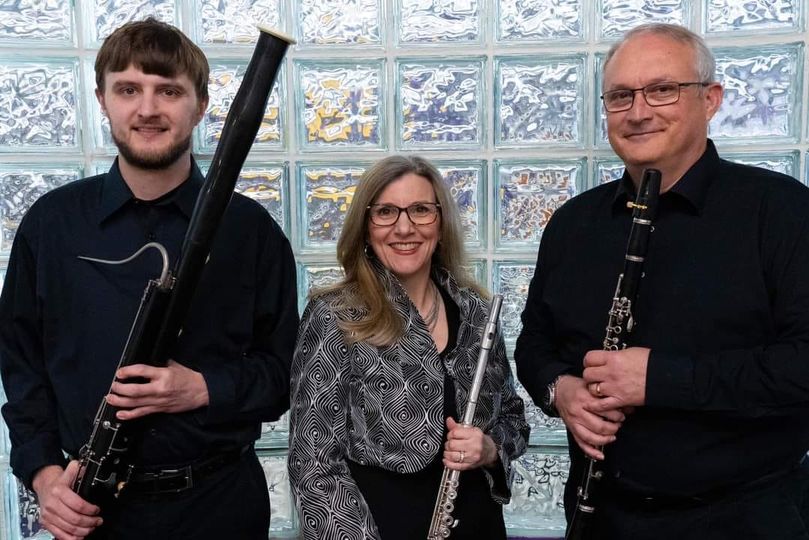
The County Line Woodwind Ensemble consists of Gwen Rakoff (flute), Gary Smith (clarinet), and George Smith (bassoon), all active musicians in the Huntsville area. Gwen is the band director at Journey Middle School in Madison, performs frequently in the area, and has degrees in music education and flute performance. Owner of Nectar Bridge by day, Gary Smith studied clarinet with Dr. Bill Bigham and has played clarinet and saxophone in several ensembles. George Smith studied bassoon with Dr. John Jinright while at Troy University, and is working on completing his CPA. Locally, he’s played with the Madison City Community Orchestra and the Twickenham Winds.
Tonight’s program will contain a number of different music styles. A woodwind trio is frankly an ensemble which is of necessity going to play a lot of transcriptions from piano and string ensembles. The flute and clarinet mainly cover soprano and alto ranges – there is a lot of overlap but you’ll generally hear the flute on the top lines (like violin) and the clarinet is often harmonizing on a 2nd voice that might be 2nd violin, viola, or occasionally down there with the upper end of the ‘cello. The bassoon is solidly a tenor instrument (like a ‘cello), and you’ll often hear it anchoring melody lines with straight quarter or eighth note beats (but everyone gets a few melody lines here).
In our opinion, the smaller an ensemble is, the shorter the piece should be. An orchestra or large wind ensemble has several sections that can take melodies and themes, pass them around, and bring it back home. Full symphonies are often works written later in a composer’s life, when they may have decided that just the coda ought to be longer than Stairway to Heaven. But for a performance like this, “brevity is the soul of wit.” We’ll play a couple of 10-15 minute pieces, and the rest of the pieces will be 2-5 minutes long.
Music We’ll Be Performing
We have a bit more than an hour’s worth of music, and we want to keep our program to an hour so you have time to enjoy the rest of the museum. So some pieces from this list may not be played. We won’t announce every tune, but we’ll let you know if we skip something.
We’ll play a few holiday tunes in the mix this time. It’s not Thanksgiving yet, but at least we’re past Halloween.
In the spirit of Whamageddon and efforts to avoid hearing “All I Want for Christmas is You” by Mariah Carey during this festive time, everything we play along those lines will be based on traditional carols and songs.
Menuetto and Trio (Franz Joseph Haydn, 1732-1809)
Trio for Flute, Clarinet, and Bassoon (Kaspar Kummer, 1795-1870, scored by Thomas Goss) – This German composer wrote a number of pieces which included flute. This one is an early ensemble for the flute, clarinet, and bassoon, as the clarinet didn’t really come into its own until the late 1700s. We’ll play the 1st and 3rd movements.
Sarabande and Corrente (Arcangelo Corelli, 1653-1713) – this may be the most distinctly baroque piece we’ll play. Corelli was a virtuosi violinist and an influential conductor and composer whose “music was key in the development of the modern genres of sonata and concerto” and even “establishing the preeminence of the violin.” (Wikipedia)
Trio in G Major (Georg Friedrich Fuchs, 1752-1821, scored by Joseph L. Wilson, Jr.) Allegro and Rondo Allegro – this is another piece which is actually a true composition for flute, clarinet, and bassoon by this student of Haydn.
In Dulci Jubilo (traditional, arranged by R. Hervig)
God Rest Ye Merry Gentlemen (traditional, arranged by R. Hervig)
Two German Dances (Mozart)
Passepied No. 1 from Orchestral Suite No. 1 in C major, BWV 1066 (Johann Sebastian Bach, 1685-1750)
The Holly and the Ivy (Traditional English Carol, arranged by David Bussick)
Finale from Trio in C (Franz Joseph Haydn, 1732-1809)